Tuesday, April 2, 2013

An Explanation of Spittin' Hard

           It’s not quite Hegelian to maintain that each generation of theorists reacts to the excesses of its predecessor. The flow chart of criticism follows this principle. There are, of course, a few basic equalizers. You either read Plato or are Plato. You are either male or de Pizan or Wollstonecraft. The next large shift is simply a function of whether or not you are going to pay attention to social tensions (a product of economic tensions) as the governor of human action. If you are, then you are going to be a Marxist, and if you are not, you are either going to have to turn to created objects or the natural world. The former will make you more interesting, the latter will make you Wordsworth.
           Criticism is neither meliorist nor dialectical. It is the via negative, determining new theoretical movements based upon the failures of Plato and then everyone else.

The Critics Spittin' Hard


Digressions on a Diagram


This diagram is of a tree, but don't be fooled. At first it may seem like those strangely large seeds are growing the tree of thought, and the higher or lower level of thinkers has something to do with progress. That's just Hegelian insistence on some positivistic dialectic model of reality. The tree just has to do with passing time, and is subject for my authorial quips concerning the placement of various thinkers in and around the tree. Also, those seeds, you may notice (as Blaine Eldredge first did) have a level of similarity to the appearance of testicles. That is an unfortunate accident.

I think it's important to note the way that they are in a sort of unified dialogue despite, or perhaps because of their differences. I also notice that's important to not over-value their thoughts. There's this idea that these thinkers are gods, but really there are times when they happen to be petty, or make mistakes, or say things they don't mean. In short, they're human beings. That's a big part of why I made this with a kind of satire or mockery in mind. Many of the catchphrases being over-simplifications or things of the sort. Think of Sidney, who is relegated to a stone beneath the earth. It's not about the insult, its about the realization that these people aren't more than other people.


Theorist Diagram


Tragedy
Plato -> Aristotle -> Nietzsche -> Freud -> Lacan -> Horkheimer/Adorno

Symbolism/Author’s intentions
Plato -> Augustine -> Maimonides -> Hume -> Kant -> Schleiermacher -> Emerson -> Nietzsche -> Freud -> Lacan -> Eliot -> Wimsatt/Beardsley

Genius
Maimonides -> Hume -> Kant -> Hegel -> Wordsworth -> Coleridge -> Emerson -> Nietzsche -> Horkheimer/Adorno

Education/Societal Impact
Plato -> Aristotle -> de Pizan -> Sidney -> Wollstonecraft -> Hegel -> Emerson -> Marx/Engels -> Horkheimer/Adorno -> Althusser -> Eliot


Most theorists consider tragedy to be one of the greatest art forms, and they usually look to Plato and Aristotle’s parameters for what is a good tragedy. Freud and Lacan take a slightly different approach, as Freud connects tragedy to the Oedipus complex and Lacan has a more tenuous connection between the imitation and mimicry in the mirror stage and Aristotle’s definition of tragedy as a representation of an action. However, neither Freud nor Lacan argue with any of Aristotle’s rules about good tragedy, and theorists such as Horkheimer and Adorno have returned to Aristotle and now complain that tragedies have become more about just punishment than about reversals and the suffering of good men. A constant problem for theorists is how to interpret symbolism in art, and how much the author’s intentions matter. Some theorists, such as Hume and Schleiermacher, think that the author’s background and intentions are vital to an accurate interpretation of their work, while others, such as Eliot, Wimsatt, and Beardsley, think that the author is irrelevant once he or she has finished the work. Augustine and Nietzsche both say that words are metaphors for other things, and both theorists have theories on how to interpret the metaphors. Freud and Lacan also believe that almost everything is a symbol representing something else, often revealing something about the author’s subconscious. Many theories have been presented regarding symbolism and how an author impacts his or her work, but none have been proved to be better than all of the others yet.
The concept of genius has been a steady theme throughout the works of many theorists. Some theorists directly use the term ‘genius,’ and some simply state ideas that match other theorists’ definitions of the term. Most often, a genius is defined as someone who is separate from most of society because of some superiority, whether it is innate or whether they were chosen to be superior. From Maimonides’ assertion that only a few can understand to Nietzsche’s Übermensch, most theorists have some theory of genius. When this theory reaches Horkheimer and Adorno, these theorists take the idea of genius in a different direction. In an attack against capitalism, Horkheimer and Adorno say that individuals are chosen to be special and admired by society, but they are chosen completely at random and so are in fact not any different from the rest of us. Finally, the question of how art affects society and how society affects art has been discussed for centuries with conflicting results. Plato believes that poetry brings out inappropriate emotions that will hurt society, while Sidney thinks that poetry supports virtue. Wollstonecraft claims that society educates us, and Horkheimer and Adorno say that society manipulates and controls us.

Joanna's Flow Chart Midterm Diagram


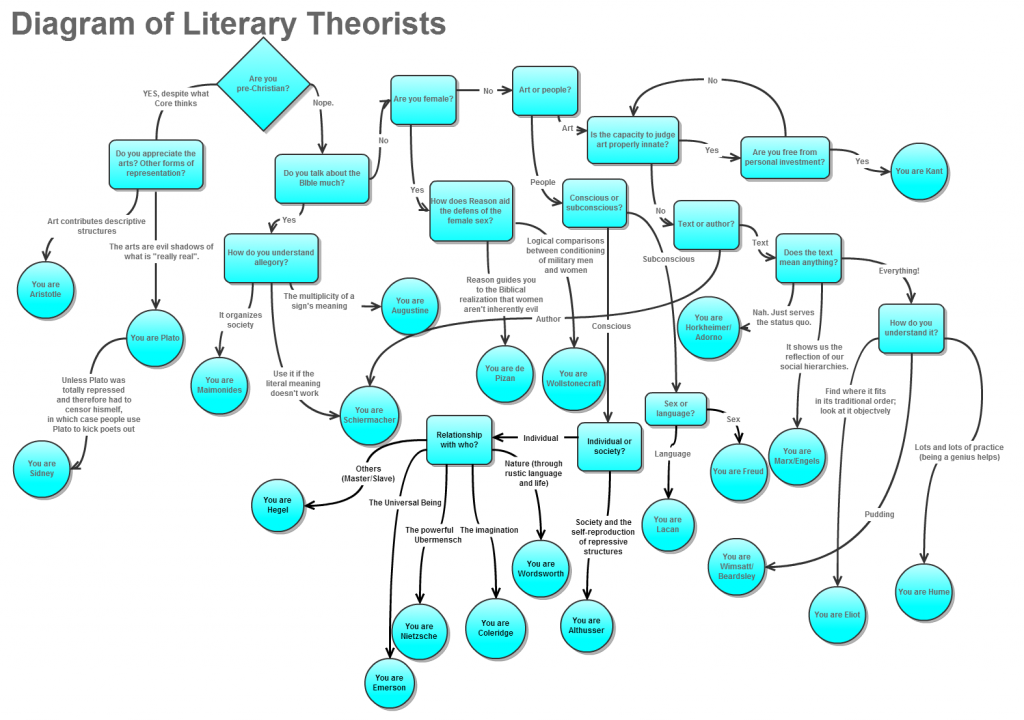
This is the small version of my chart: 
See why you need the larger version?

This flow chart is meant to map out the relationship of main ideas between these theorists. There are some theorists whose main ideas are not in direct relation to other theorists of their time. Sidney, for example, lived almost 2,000 years after Plato, yet he responds directly to Plato's arguments. de Pizan and Wollstonecraft, though their lines are quite separate from all the others (they follow a rather unique path) are not entirely disconnected. Their particular lines are separate, but they are directly in the middle of the chart, surrounded by the other theorists. These two women wrote about different things than other critics; they focused (especially in our readings) on women's rights. Their prominent ideas might have been separate, but their writing, their rhetoric, and their backgrounds were completely caught up in the writings and histories of these other theorists.

The chart sort of explains itself as you go along, so not much extra explanation is needed. The most multi-faceted section of the chart is "Relationship with who?" This is after the importance of the individual is determined. "Relationships with who?" leads to Others (Master/Slave), The Universal Being, The powerful Ubermensch, The imagination, and Nature. While I previously understood Coleridge, Emerson, and Wordsworth to be related, it was only through this question ("Relationships with who?") that I really understood them. The fact that Nietzsche and Hegel both fit under this headline is fascinating, and it allows me to see them in a different light. This chart is not meant to be the  most accurate and complete diagram of theorists' relationships ever. It is a flow chart pointing out possible directions of thought and connection.

Monday, April 1, 2013

Evans Midterm Part 1

Map of Influence


Key
(Just in case the zoom doesn't work, here is a link to Google Drive:  https://docs.google.com/document/d/15TejlYv4vrtX4Yd64BJE2rYO2x5016PR37LjWxKGypc/edit?usp=sharing)


My diagram is in roughly chronological order from top to bottom, with colors marking the different critical groupings (the large red circle, for example, represents Romanticism).  Blue arrows indicate that one theorist has marked influence on another. Arrows with red outlines indicate that a theorist was reacting to another (or to the previous critical movement). Under each theorist's name is a brief paraphrase of his or her views on the relationship between art and truth; more specifically, I tried to think of each theorist's answer to the question "how do we judge art?" or "how do we look at literature?"  Though these statements obviously do not include all discussed ideas of each theorist, I thought the repetition of these ideas would more clearly show the theoretical evolution from Plato to Althusser.
I suppose I should not have been surprised at the extent to which the texts are interrelated, but I found the relationships staggering.   Schleiermacher, especially, seemed to show up when I least expected him, especially in his views about the reciprocal relationship between historical context, language, and art.  In a future draft of this diagram, I would want to find a clearer way to represent the relationships between theorists; I realize it is not quite comprehensive, but I feared that adding arrows would make it unreadable.  There should be, for example, a very large arrow from Augustine to De Saussure (concerning their discussions of signs), but adding it only made the diagram confusing.  Finally, in a future draft, I would want to find a way to connect theorists beyond their critical moments. If, for example, I could find a way to connect the Romantics (Wordsworth, Coleridge, and Emerson) to Schleiermacher in their value of the author, and also group the New Critics and the Structuralists in their dedication to the "Death of the Author," I would be more satisfied. Similarly, if I could group Wollstonecraft, Marx, Horkheimer and Adorno, and Althusser together (because of their tendency toward social criticism), I think it would be more complete.  To achieve all of this, however, I think I would have to begin again using a sort of enormous Venn Diagram, a feat I will leave to someone with better academic credentials.

Strausbaugh,Derek's Midterm Diagram


     In this diagram, I started at the very beginning, with Plato, because his work interacts with all other critics we have examined. Plato leads directly to Aristotle, who expands and refutes Plato's ideas. The next generation of philosophers, Augustine, Sidney, and Maimonides deal with different aspects of text than Aristotle, but seem to be out of the same critical tradition. I loosely connect Maimonides with Schleiermacher because they both deal with hermeneutics. Emerson also deals directly with Schleiermacher's Ideas.
     Hegel and Kant wind up side by side because they both represent huge influential ways that changed the way people though, Hegel with the dialectic and Kant centering goodness around the human being. This leads directly into Hume's ideas of taste, which Eliot runs with. Coleridge, Wordsworth, and Emerson all draw from Hume and his idea of taste, and expand upon that with ideas of how the poet should compose works, and how inspiration works. Marx and Engels splinter off from the romantics, rebelling from the notion that all humanity believes in the same ideals of art, and posit that taste is manufactured in society by those who control production. Horheimer, Adorno, and Althusser expand upon Marx and Engels by getting more specific as to how the society creates its own norms. Similarly, Wollstonecraft rebels against previous notions of taste stating that Gender has been a factor in the past. Pizan is linked to Wollstonecraft in her ideas. Freud is another rebellion from humanity having an innate sense of beauty. He puts for the idea that our psychology and experiences determine what we deem tasteful. Lacan and Nietzsche both draw from Freud, moving his theories into different arenas and expanding upon them. Lacan uses the Idea of the sign in order to accentuate language as a system of symbols. De Saussure take that idea and expand upon it. Wimsatt and Beardsly take that idea to the next level saying that the text is the only thing that matters, because everything that there is to know about a text is in the signs.